Biopharmaceutical and medical device
development generally faces challenges such as long development cycles and
stringent regulatory requirements. In response to these pressures, sponsors
(i.e., pharmaceutical or medical device companies) increasingly rely on contract
research organizations (CROs) to access specialized
expertise, control costs, and accelerate project timelines.
A CRO, or contract research organization,
is an entity that provides outsourced research and development services to
pharmaceutical, biotech, and medical device companies under contract. In simple
terms, a full-service CRO acts as an extension of a sponsor's internal team,
managing part or all of the research process on their behalf.
CRO services typically span the entire
product lifecycle, from early drug discovery through preclinical testing,
clinical trials, regulatory submission, and post-market surveillance. This
breadth allows a CRO company to support sponsors at any stage, whether launching a first
study or scaling a global program.
For a deeper understanding of how
CROs are defined and positioned within the industry, see: What Is a CRO? Contract Research Organizations & Clinical Research Organizations
Common
Types of CRO
CRO companies are generally grouped by the
scope of their offerings:
· Full-service CRO: delivers end-to-end,
one-stop solutions covering discovery, preclinical, clinical, and post-market
phases.
· Specialty
CRO: focuses on a single service area, such as
biostatistics, central lab testing, or site management only.
In
addition, CROs can also be classified according to other dimensions. For
example, based on business type, CRO companies can be divided into two major
categories:
· Non-clinical research services: primarily covering drug discovery and
preclinical-stage research.
· Clinical CRO services: primarily covering clinical-stage research, along
with subsequent drug approval and market launch support.
What Services Does a CRO Provide?
A contract research organization, or CRO,
provides specialized services covering drug discovery, preclinical research,
clinical research, regulatory submission, and post-market research, tailored to
the R&D needs of pharmaceutical or biotechnology companies. CRO
services can focus on a single stage or form an integrated, one-stop support
system across the entire development pathway.
CRO Services Across Drug Development Stages
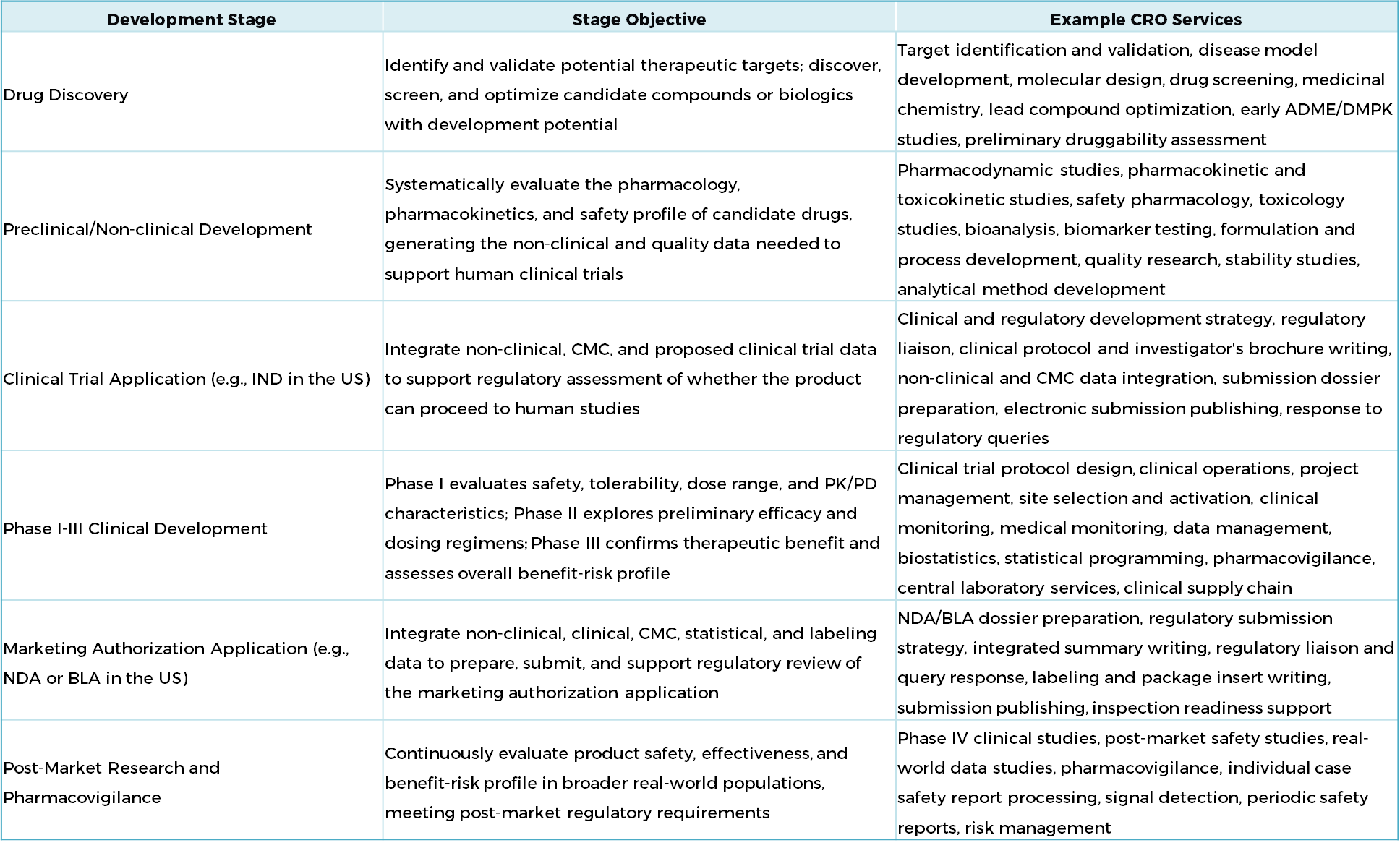
Note: The stages and services outlined above are
for general reference only, as actual development pathways and technical
requirements may vary across different drug types.
The Benefits of Partnering with a CRO Company
Partnering with a CRO addresses several
recurring challenges in drug and device development.
· Accelerated trial timelines: dedicated
teams and established site networks reduce startup delays and enrollment
bottlenecks.
· Cost efficiency: outsourcing avoids the
fixed overhead of building internal research infrastructure for every program.
· Access to specialized expertise:
therapeutic-area teams bring experience across oncology, immunology, cell and
gene therapy, and other complex fields.
· Regulatory support and compliance: CROs track
evolving requirements from agencies such as the FDA, NMPA, and EMA, helping
sponsors avoid submission delays.
· Operational flexibility: Sponsors
can scale resources up or down as project scope changes, without committing to
permanent headcount.
· Access to advanced technology platforms:
CROs often maintain data management systems, AI-assisted analytics, and
decentralized trial technologies that would be costly for a single sponsor to
build independently.
These benefits explain why sponsors of
varying sizes, from emerging biotech firms to multinational pharmaceutical
companies, continue to expand their use of clinical research services.
How to Choose a CRO Company
Selecting a partner requires evaluating
capabilities against the specific demands of a program. The question of how to
select a CRO usually comes down to five practical criteria.
1. Areas of expertise: confirm experience
in the relevant therapeutic area and study phase.
2. Geographic coverage and site network:
check the breadth of principal offices, lab facilities, and active clinical
sites across the regions where the trial will run.
3. Regulatory knowledge and compliance:
assess familiarity with the specific health authorities involved, including
submission history and inspection track record.
4. Scientific and technical capabilities:
evaluate demonstrated experience and delivery track record in core technical
areas such as biostatistics, medical writing, pharmacovigilance, and data
platforms.
5. Project management and communication:
evaluate how the CRO structures oversight, reporting, and coordination across
multi-region teams.
A structured comparison across these five
dimensions helps sponsors avoid mismatches between project needs and vendor
capacity, particularly when searching among top global contract research organizations
with integrated technology services.
Explore Tigermed’s 180+
offices across Asia Pacific, Europe, North America, Latin America, and Africa: Global Locations
Tigermed is a global, integrated CRO serving the
biopharmaceutical and medical device industries. We provide end-to-end services
spanning preclinical research, clinical development, regulatory submissions,
and post-market research. As of August 2026, we have more than 100
subsidiaries, over 11,000 employees, and more than 180 offices worldwide, and
have served over 4,000 clients. Supported by our global operational network and
capabilities in clinical research, regulatory affairs, biostatistics, and
digital technologies, Tigermed provides sponsors with integrated support
throughout the R&D lifecycle.
To learn
more about Tigermed’s global capabilities and R&D solutions, please get in touch with us.