The COVID-19 pandemic provided an important
backdrop for the accelerated adoption of decentralized clinical trials (DCTs).
In recent years, as digital health technologies (DHTs), telemedicine, wearable
devices, and artificial intelligence (AI) continue to evolve, the use of DCTs
in global clinical research has continued to expand and is gradually moving
toward scale and integration.
Although digital tools were initially designed
to address operational bottlenecks in traditional trials, early implementation
often created fragmented workflows. Today, clinical research is shifting from
simply adopting technology to building a coordinated, patient-centric
integrated model.

What Are Decentralized Clinical Trials (DCTs)?
In standard research practice, decentralized
clinical trials refer to studies where some or all trial-related activities
occur outside traditional physical trial sites. By using connected health devices, home
healthcare visits, telemedicine, and direct-to-patient logistics, DCTs bring
research procedures directly to participants in their local communities or
homes.
Background: The Emergence of DCTs
Traditional clinical trials depend almost
entirely on physical, brick-and-mortar research sites. Under this conventional
setup, participants frequently encounter geographic barriers, travel expenses,
and scheduling conflicts that impede enrollment and protocol adherence.
During the COVID-19 pandemic, these mobility
constraints prompted the rapid implementation of remote trial solutions as an
emergency response. As the operating landscape stabilized, sponsors recognized
that remote methodologies could serve as strategic models to support trial
resilience and participant engagement.
DCTs vs. Traditional Clinical Trials
Similarities
Traditional clinical trials and DCTs are built
on the same ethical, regulatory, and scientific foundations. Both models are
required to comply with Good Clinical Practice (GCP) and applicable
international guidelines, including ICH E6 (GCP) and its latest revisions.
Under both frameworks, investigational medical
products must be systematically tracked, participants must provide
comprehensive informed consent, and principal investigators retain ultimate
medical oversight and legal responsibility for trial conduct.
Differences
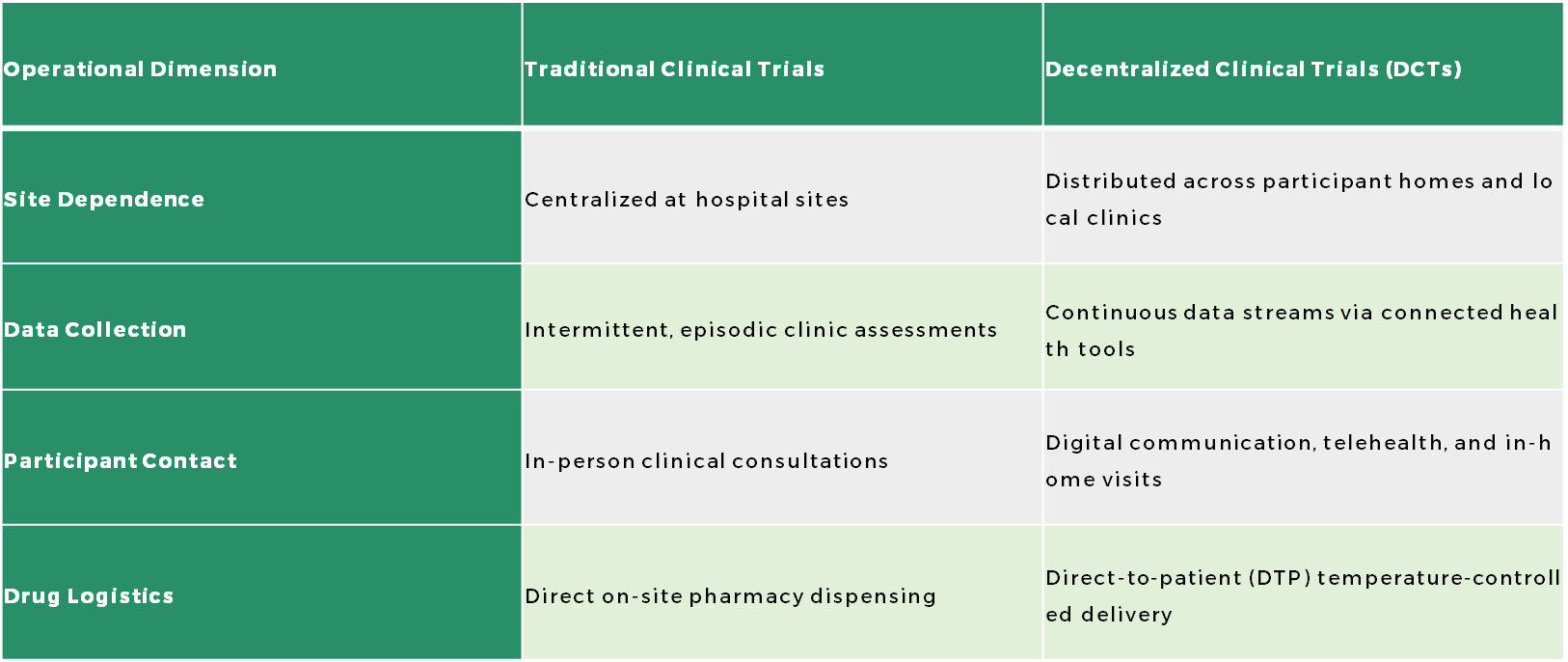
The primary differences between the two models
center on visit location, data acquisition frequency, and logistics:
Types of DCTs
Decentralized research does not follow an
all-or-nothing approach. In industry practice, virtual clinical trials are
classified into three operational models:
· Fully Decentralized Trials: All screening,
informed consent, product administration, and safety follow-ups occur remotely
without physical clinic visits. In our three-year survey tracking (n=2,776),
fully remote clinical trials declined from 19.9% in 2023 to 9.1% in 2024,
before stabilizing at 13.6% in 2025.
· Hybrid Clinical Trials: These protocols
selectively combine traditional on-site visits with remote operational
components. Hybrid clinical trials represent the primary operational
model across the industry, demonstrating consistent
adoption rates of 32.4% in 2023, 29.4% in 2024, and 31.1% in 2025.
· Traditional Site-Based Trials with Digital Support: Conventional site execution supported by isolated point solutions,
such as electronic data capture.
Sources
All data in this article
are based on Tigermed’s white paper: From
Adoption to Integration: A Three-Year Evolution of Decentralized Clinical
Trials in the Era of AI and Digital Health Technologies
(June 2026). In
the event of any updates, the latest version of the white paper shall prevail.
Three Key Advantages of DCTs
1. Improving Participant Accessibility and Recruitment
Efficiency
Geographic distance often limits patient
accrual in conventional site-based studies. By enabling remote pre-screening and
home-based procedures, decentralized trials expand recruitment reach into
regional and underserved populations. This decentralization helps compress
recruitment timelines and broadens demographic diversity.
2. Enhancing the Participant Experience and Retention Rates
Frequent travel to investigative centers can
cause substantial participant fatigue, leading to protocol dropouts.
Incorporating home nursing visits, direct drug delivery, and virtual
consultations allows patients to participate within their everyday routines,
supporting treatment compliance and long-term retention.
3. Enabling More Continuous Data Collection and Improving
Real-World Relevance
Standard clinical evaluations provide periodic
snapshots that are vulnerable to patient recall bias. By deploying
medical-grade digital health technologies, studies can capture continuous,
objective physiological measurements in real-world settings.
In our survey, 32.5% of stakeholders cited
enhancing data objectivity and continuity as their primary rationale for
adopting digital tools, while 23.1% used them to support novel digital endpoint
development.
Key Technologies and Service Modules of DCT
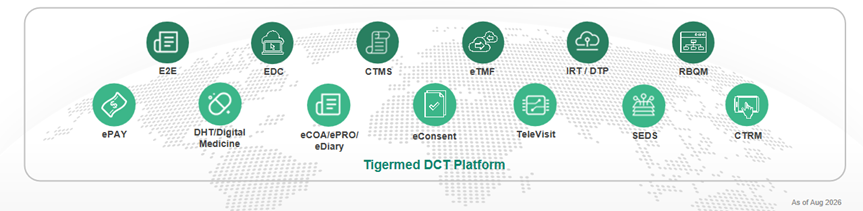
DCT implementation relies on integrated
technical and operational capabilities across two levels:
For Investigational Sites and Clinical Operations
· E2E: Utilizes large language models to extract
protocol variables from electronic source data directly into EDC, improving
data timeliness and quality while reducing overall costs.
· eConsent: Delivers remote visual informed
consent, ensuring trial participants receive study information thoroughly and
promptly.
· eCOA: Standardizes electronic clinical data
evaluations to elevate data reliability and workflow efficiency across clinical
sites.
· TeleVisit: Facilitates secure remote study
visits, enabling direct and convenient communication between investigators and
participants.
· Remote Recruitment: Digital screening tools
that evaluate candidate eligibility using structured digital pathways.
· Remote Monitoring: Enables clinical monitors
to review electronic source records and track safety signals off-site via
secure platforms, ensuring real-time data integrity while reducing on-site
monitoring expenditures.
For Participants and Decentralized Operations
· IRT/DTP: Combines direct-to-patient
distribution with medication traceability coding, enhancing dosing convenience
while safeguarding protocol blinding integrity.
· ePRO/eDiary: Captures patient-reported
outcomes directly, supporting participant compliance while enhancing data quality
and collection efficiency.
· ePAY: Provides automated third-party stipend
payments, reducing participant financial burdens and safeguarding participant
rights.
· DHT/Digital Medicine: Deploys a comprehensive
digital healthcare framework to empower continuous, objective clinical data
collection.
· CTRM & RBQM: Integrates remote monitoring with
risk-based centralized monitoring, enhancing study quality while controlling
clinical trial expenditures.
Deploying these DCT technology components and
DCT elements within a cohesive ecosystem helps reduce operational fragmentation
across study teams.
Which Clinical Studies Are Suited for DCTs?
Suitability depends on trial phase, protocol
complexity, and drug safety profiles. Survey data show a distinct transition away from
exploratory and post-marketing settings toward critical commercial phases:
— In 2023, decentralized methods were concentrated in Phase IV surveillance
(54.8%), real-world studies (32.3%), and investigator-initiated trials (IITs; 29.6%).
— By 2025, Phase IV application decreased to 11.8%, and
investigator-initiated trials declined to 8.8%. Conversely, DCT utilization in pivotal
commercial trials remained strong in 2025, accounting for 19.7% in Phase II and
25.2% in Phase III studies.
Common Global Applications of DCTs
Globally, decentralized
clinical trial elements are widely applied across key therapeutic areas,
including:
· Rare Diseases
· Oncology
· Central Nervous System (CNS) Disorders
· Cardiovascular
and Metabolic Conditions
In China, research findings indicate that
decentralized trial adoption is mainly concentrated in therapeutic areas with
large patient populations and high clinical demand.
l Oncology maintained the highest DCT adoption rate, stabilizing at 12.2% in 2025, followed by cardiovascular and
metabolic diseases at 10.8%, dermatology at 7.8%, CNS disorders at
7.2%, and hematology at 5.2%.
Key Implementation and
Operational Challenges in DCTs
As DCTs advance toward scale and integration, early deployments designed
to solve traditional trial bottlenecks have exposed new layers of operational
friction. In evaluating this transition, research findings identify several key
structural, operational, and regulatory challenges:
· Platform Fragmentation and Digital Overload:
Deploying multiple disconnected digital tools creates workflow friction,
requiring research sites to navigate multiple isolated software portals.
· Source Data Management and Interoperability:
Integrating novel digital endpoints into existing clinical systems remains
difficult in the absence of unified data standards.
· Role Ambiguity in Multi-Vendor Environments:
The involvement of multiple independent technology and logistics vendors
frequently blurs operational boundaries and oversight accountability.
· Operational Burden at Trial Sites: Research
centers often encounter staffing constraints and incomplete standard operating
procedures (SOPs) tailored to decentralized trial workflows.
· Regulatory and Cross-Border Privacy Complexity:
Navigating divergent international data protection frameworks and evolving
compliance expectations creates ongoing execution uncertainty.
· Participant Usability Barriers: Technical
hurdles and digital literacy gaps can limit engagement and compliance among
specific patient populations, particularly elderly participants.
These challenges show that simply using
isolated digital tools cannot solve operational problems. Overcoming these
hurdles requires an integrated partner who can connect digital tools, site
operations, and regulatory compliance into a coordinated, patient-centric
model.
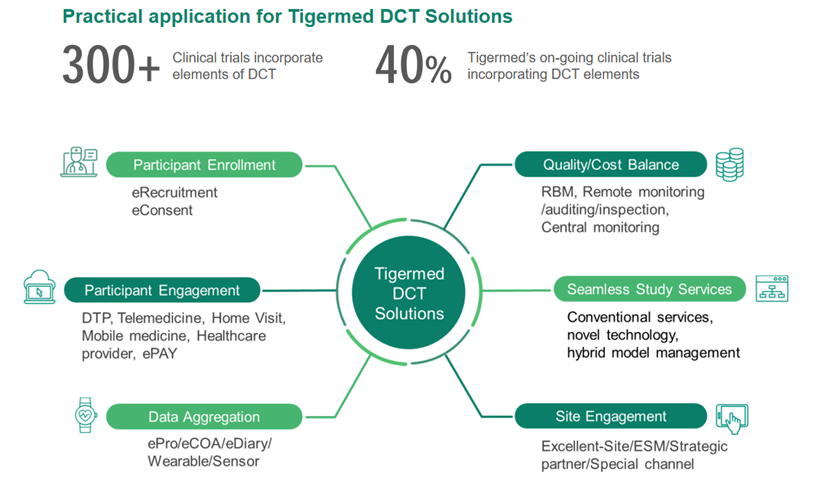
Why Choose Tigermed for DCTs?
As DCT
adoption continues to mature, the focus is increasingly shifting toward
integrated, patient-centric trial design. Because decentralized trials have
become an integration challenge, the value of an experienced Contract Research
Organization (CRO) is no longer simply providing individual tools, but
orchestrating the entire DCT ecosystem.
At
Tigermed, we unite clinical operations, regulatory governance, and digital
health tools into a cohesive model. By connecting site workflows with
patient-friendly remote services, we help reduce investigators' administrative
burden, enhance the participant experience, and maintain strict data integrity.
To further
discuss customized DCT or CRO solutions, please visit the official Tigermed
website or contact our team
directly.
FAQs
1. What
is the difference between traditional clinical trials and DCTs?
Traditional
clinical trials require participants to visit designated research sites for all
study visits, drug administration, and clinical assessments. In contrast, DCTs
use digital tools, remote monitoring, and direct-to-patient logistics to
distribute these activities across participants’ homes or local healthcare
facilities.
2. Can
DCTs improve participant recruitment and retention?
Yes. By
reducing travel burdens to trial sites and offering remote pre-screening along
with home visits, decentralized models make study participation much more
convenient. This flexibility expands geographic reach, helping to improve
participant compliance and retention rates throughout the trial lifecycle.
3. What
are the potential applications of AI in DCTs?
AI is
primarily applied to automate complex operational workflows, such as data
management and anomaly detection, patient recruitment and cohort screening, and
medical and safety monitoring. The industry views AI not only as an analytical
tool but also as a proactive platform for orchestrating clinical trials.
Widespread
AI integration remains exploratory and evolving.