Global drug development requires coordinated execution across
scientific strategy, clinical sites, data management, patient safety,
regulatory requirements, and project delivery. A full-service contract research organization (CRO) can
bring these functions together within a coordinated operating model, while
drawing on specialist support where appropriate.
This article introduces eight established providers with broad
clinical development capabilities. The selection considers service scope,
multinational delivery, lifecycle coverage, and relevance to different sponsor
needs. It is intended as a general industry reference rather than a ranking or
comparative assessment.

What Defines a Full-Service CRO?
Under a full-service outsourcing model, a CRO performs or
coordinates most or all agreed study activities through an integrated delivery
structure. Depending on the program, the scope may include protocol development
support, study start-up, site management, clinical monitoring,
biometrics—including data management, biostatistics, and statistical
programming—medical writing, pharmacovigilance, regulatory submissions, and
study closeout. The sponsor nevertheless retains ultimate responsibility for
its trial-related activities, including the protection of participants’ rights,
safety, and well-being and the reliability of trial data.
The appropriate model depends on the asset, development phase,
geographic scope, and sponsor organization. Emerging biotechnology companies
may require close scientific collaboration, flexible resourcing, and turnkey
end-to-end management from early-stage translational research through clinical
proof of concept, while larger pharmaceutical companies may place
greater emphasis on portfolio governance, standardized systems, and consistent
delivery across multiple countries.
Sponsors should therefore assess not only the breadth of a
provider’s service portfolio, but also its contracting structure, local
delivery model, quality oversight, use of subcontractors, and allocation of
responsibilities.
▶ Tigermed
▶ IQVIA
▶ PPD
▶ ICON plc
▶Parexel
▶Syneos
Health
▶Fortrea
▶Medpace
Learn more about the
concept of CROs: What
Is a CRO? Contract Research Organizations & Clinical Research Organizations
1. Tigermed
Tigermed provides
comprehensive, integrated full-service solutions spanning the entire drug
development lifecycle, including preclinical research, laboratory testing, clinical
development, regulatory affairs, site and participant management, and
post-market research.
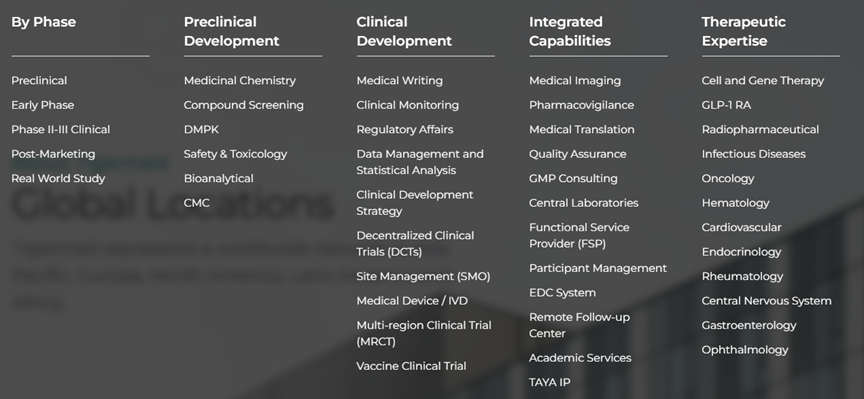
CRO Services offered by Tigermed
With its Global Headquarters in Hangzhou and International
Headquarters in Hong Kong, Tigermed combines its Asia-Pacific presence with
global operations. The company is dual-listed on the Shenzhen Stock Exchange
and the Hong Kong Stock
Exchange, forming an “A+H” capital-market platform.
As of June 30, 2026, Tigermed had 11,984 employees across 43
countries and 667 ongoing drug clinical research projects, including 264
ongoing overseas projects. During the same period, Tigermed had provided
services for 210 approved Class 1 innovative drugs in
China, representing 62% of all such drugs approved in China. According
to Frost & Sullivan data cited in Tigermed’s 2026 Interim
Results, Tigermed
maintained its leading position in China’s clinical CRO market in 2025, with a
market share of 10.9%, and remained
the only Chinese clinical CRO ranked among the global
Top 10.
For international sponsors developing products, Tigermed supports
early-stage development, regulatory registration, and investigator-initiated
trials, while coordinating these activities with broader global programs. Its integrated
service model is complemented by digital capabilities in decentralized clinical
trials and AI-supported workflows. These include tools for medical writing,
regulatory submissions, biostatistics, translation, and pharmacovigilance,
together with continued investment in DCT research and clinical trial AI applications.
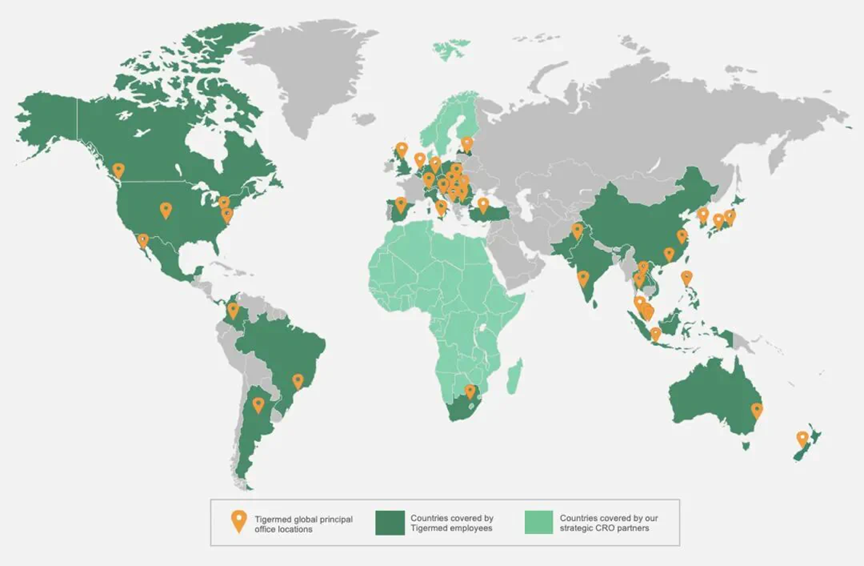
Tigermed Global Principal Office Locations
2. IQVIA
IQVIA combines clinical development services with healthcare data,
analytics, and technology. Its research and development portfolio includes
early-phase studies, Phase IIb and III trials, patient and site services,
functional services, global laboratories, and R&D consulting.
The company also provides services in real-world evidence, safety,
and regulatory compliance. Through IQVIA Biotech, it supports emerging
biopharmaceutical companies from early development through global registration
programs.
3. PPD, Part of Thermo Fisher Scientific
The PPD clinical research business provides services across early
development, all phases of clinical research, and peri-approval and
post-approval programs. Its capabilities include patient recruitment,
investigator and site support, clinical operations, and laboratory services.
PPD offers both full-service and functional service partnership
models. As part of Thermo Fisher Scientific, it can also connect clinical trial
delivery with a broader range of laboratory and analytical capabilities. Its service
portfolio supports pharmaceutical, biotechnology, medical device, and
government organizations.
4. ICON plc
ICON provides clinical development and commercialization services
across Phase I to IV studies. Its capabilities include consulting, study
operations, site and patient access, functional services, and decentralized or
hybrid trial delivery.
The company supports both locally focused studies and multinational
development programs. Its operating profile identifies full-service Phase II
and III research and services for biotechnology sponsors among its core areas.
5. Parexel
Parexel provides Phase I to IV clinical development services through
an integrated portfolio covering early development, clinical operations,
regulatory strategy and submissions, real-world evidence, market access, and
lifecycle management.
Its services support a range of therapeutic areas and development
approaches, including oncology, neuroscience, immunology, rare diseases, and
cell and gene therapies. The company’s global service portfolio may be relevant
to sponsors seeking regulatory and market-access expertise alongside clinical
trial delivery.
6. Syneos Health
Syneos Health combines full-service clinical development with
functional service partnerships and commercial capabilities. Its clinical
development services cover early-phase research, Phase II to IV studies,
real-world evidence, study start-up, patient recruitment, safety, regulatory
affairs, bioanalysis, biometrics, and decentralized or hybrid trials.
Its operating model is designed to connect clinical development with
medical affairs and commercialization planning. This may be relevant to
sponsors considering development and commercialization requirements within a
coordinated framework.
7. Fortrea
Fortrea provides Phase I–IV clinical trial management, clinical
pharmacology, and market access solutions through full-service outsourcing,
functional service provider, and hybrid delivery models. Its capabilities
support both focused proof-of-concept studies and larger multinational
programs.
Fortrea completed its spin-off from Labcorp in 2023 and now operates
as an independent CRO providing clinical development and patient access
solutions. Its global operating network and dedicated early-phase clinical
research units support studies requiring execution across multiple regions.
8. Medpace
Medpace is a global full-service CRO supporting Phase I–IV clinical
studies. Its integrated operating model includes wholly owned central and
bioanalytical laboratories, imaging and ECG core laboratories, a Phase I unit,
and its proprietary ClinTrak clinical trial management system.
The model is structured around cross-functional coordination
throughout the study lifecycle. Medpace serves biotechnology, pharmaceutical,
and medical device sponsors across a range of therapeutic areas.
How to Evaluate Full-Service CROs
A CRO shortlist should begin with the requirements of the protocol
and development program rather than company size alone. When evaluating
full-service partners specifically, sponsors should assess:
· End-to-End
Lifecycle Integration and Scope Continuity: The ability to support preclinical testing,
early clinical pharmacology, Phase I–IV multicenter studies, and
post-marketing research under unified project governance, reducing the
risks and administrative burden associated with multiple vendor handoffs.
· Scientific and
Development-Phase Alignment: Therapeutic-area expertise, study design
capabilities, and experience with the relevant product modality,
development stage, and clinical endpoints.
· Site Access and
Patient Recruitment Capabilities: Access to hospital and site networks, Phase I
research resources, and dedicated site management organization (SMO) teams
and clinical research coordinators (CRCs) to support timely site
activation and patient enrollment in key markets.
· Geographic Coverage
and Local Execution: Local teams, site relationships, regulatory
knowledge, language capabilities, and cross-border data-management
processes across relevant regions.
· Delivery Model and
Accountability: Clear
allocation of responsibilities under full-service, functional service
provider (FSP), or hybrid arrangements, with defined escalation pathways,
cross-functional coordination, and team continuity.
· Quality Systems and
Technology Capabilities: Quality management systems, regulatory
inspection experience, validated systems, cybersecurity controls,
data-integrity practices, and appropriate human oversight of AI-supported
workflows.
· Commercial
Transparency and Governance: Clear budget and timeline assumptions,
pass-through costs, change-control procedures, contractual governance, and
sponsor access to relevant operational data.
No single operating model is appropriate for every development
program. Sponsors should evaluate each provider against the scientific,
operational, regulatory, geographic, and commercial requirements of the
specific study.
For programs connecting China with other markets, Tigermed combines
experience in China’s clinical and regulatory environment with local
international teams, integrated services, and coordinated global delivery.
Learn more about CRO
services and how to choose the right CRO partner: What
Are CRO Services and How to Choose the Right CRO Company?
Conclusion
A CRO partner that is highly aligned with the specific needs of a
development program can help sponsors optimize research processes, improve
operational efficiency, reduce execution risks, and support the successful
advancement of innovative products from clinical development through regulatory
approval and commercialization.
For sponsors seeking to accelerate global clinical development,
Tigermed leverages its global operational network, integrated clinical service
capabilities, and extensive cross-regional development experience to provide
tailored solutions. To learn more about global clinical development services,
please contact the Tigermed team
for further discussion.
*
Disclaimer
All company
names, trademarks, and logos mentioned in this article are the property of
their respective owners. This article is provided for general informational and
industry reference purposes only and does not constitute an official ranking,
endorsement, recommendation, or evaluation of any CRO provider.
The companies
mentioned in this article are included solely for industry discussion and
reference purposes. The inclusion and order of these companies do not represent
a ranking or comparison of their performance, service quality, capabilities, or
market position, nor do they imply any affiliation, partnership, or commercial
relationship with Tigermed.
The information
presented in this article is based on publicly available sources at the time of
publication and may change over time. This article does not constitute medical,
scientific, regulatory, legal, procurement, financial, or investment advice. Sponsors
should independently verify each provider’s current capabilities,
qualifications, compliance status, service availability, and commercial terms,
and conduct appropriate due diligence based on their specific needs before
selecting a CRO partner.